


Marine-Life First Aid for Divers: Stings, Spines, Cuts and Bites
What Divers Alert Network advises for venomous fish stings, sea urchin spines, jellyfish and fire coral, coral cuts and bites, and when to get medical help fast.
A brush against fire coral, a spine in your knee on a shore entry, a sting from a jellyfish you never saw. Most marine-life injuries are small, and most could have been avoided. When one happens, knowing the first steps makes a real difference. Here is what Divers Alert Network (DAN) advises.
This is general information, not medical advice, and it does not replace first-aid training. For any serious symptom, such as difficulty breathing, weakness, vomiting, collapse or a large affected area, call local emergency services first. Divers can also call the DAN Emergency Hotline on +1-919-684-9111.
The best first aid is not touching
Nearly every injury below starts with contact. DAN advises avoiding contact with coral and any other living creature, wearing a wetsuit or dive skin when you can, taking care on shore entries over rocky bottoms, and keeping good buoyancy in shallow water and around wrecks. Green Fins asks divers never to touch marine life at all. Our eight habits of reef etiquette protect you as much as the reef.
Venomous fish: lionfish, scorpionfish and stonefish
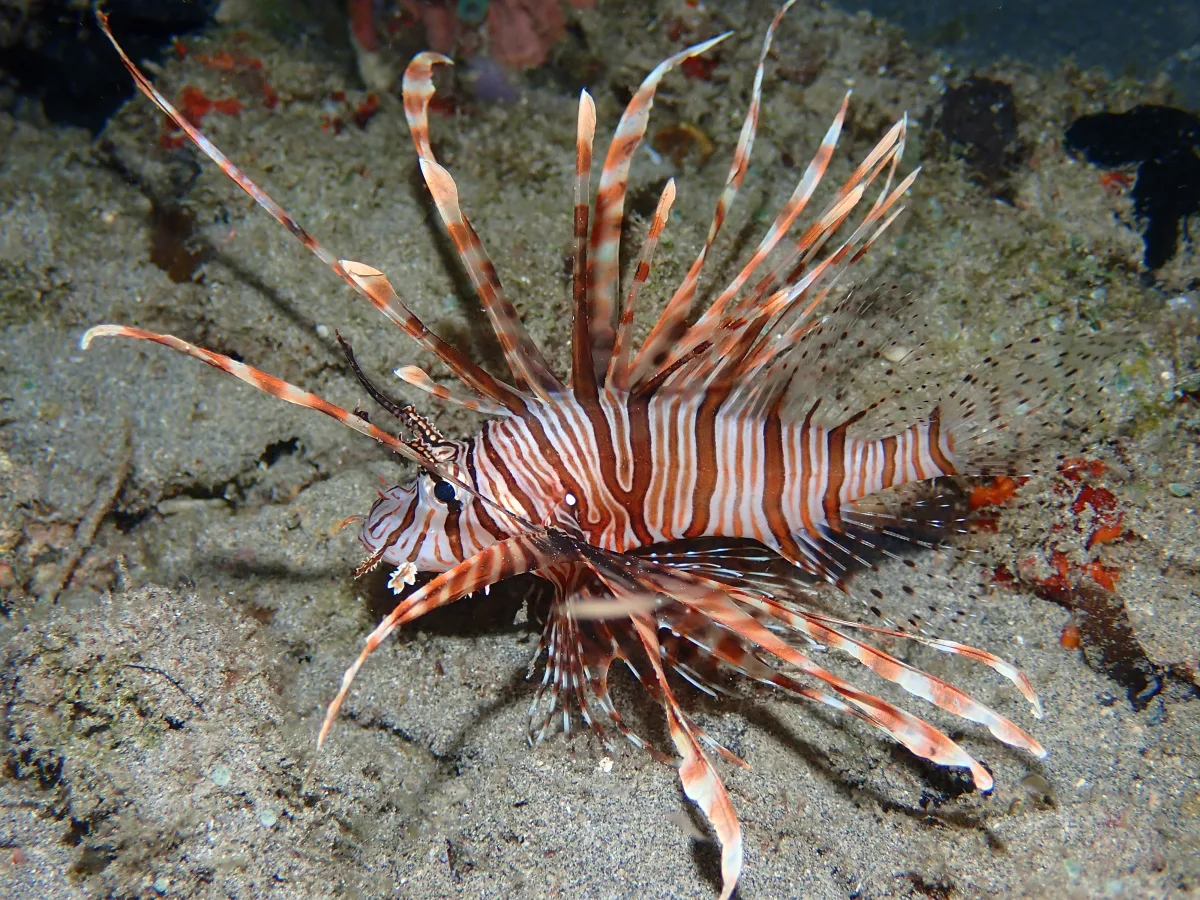
These fish carry venom in their spines. DAN's Alert Diver (Becker and Auerbach, 2011) says lionfish stings can cause significant pain but are rarely fatal, while the stonefish can deliver a fatal sting.
- Hot water. Soak the wound in hot water, 43 to 45°C (110 to 113°F), but never scalding. Test the water on yourself first, because a person in severe pain cannot judge the temperature. For spine injuries DAN gives 30 to 90 minutes, repeated if needed.
- Clean the wound. Remove as much of the spine and foreign material as you can, wash the wound well with clean fresh water, scrub it with soap and rinse again. Spines deep in the body, especially the chest or abdomen, should only be removed in hospital.
- Stonefish. DAN notes that heat may do little for stonefish pain but may break down some of the harmful parts of the venom, so it is still recommended. Antivenom exists in the South Pacific and Australia, and should only be given in hospital.
- Get help fast if the person seems more than mildly ill, or shows weakness, vomiting, shortness of breath or loss of consciousness.
Sea urchin spines
- Soak the area in hot water, no hotter than 45°C (113°F), for 30 to 90 minutes, testing the water on yourself first.
- Remove spines near the surface with tweezers. They are hollow and break easily. Do not try to remove spines embedded deep in the skin.
- Wash the area thoroughly, but without forceful rubbing or scrubbing while spines may remain. Apply an antiseptic or antibiotic ointment if you have one.
- Do not close the wound with tape or glue, and have it checked by a medical professional as soon as reasonably possible (DAN).
Jellyfish, fire coral and hydroids
DAN groups these together, because they all sting with tiny stinging cells that can keep firing after contact.
- Rinse with seawater, not fresh water. A gentle fresh-water rinse is more likely to make the cells fire.
- Decontaminate. Apply a decontaminant such as vinegar liberally for 30 minutes or until the pain eases.
- Do not handle tentacles, even ones that look dried out. After decontaminating, DAN suggests shaving cream or soap and a razor to remove remaining stinging cells.
- For pain, a cold pack can help; wipe the skin dry first and never put ice directly on the skin.
- See a doctor if a whole limb, the face or genitals are affected, if the person is very young or very old, or if they feel generally ill.
Box jellyfish are a different level of danger. DAN says there are species in almost all tropical and subtropical seas, and that certain species can kill an adult in as little as three minutes. Call emergency services, do not rub the skin, pour vinegar over the area for at least 30 seconds, keep the person still, and be ready to give CPR.
Coral cuts and scrapes
DAN warns that cuts from sharp-edged coral and barnacles tend to fester and can take weeks or even months to heal, so treat them properly straight away:
- Scrub the cut vigorously with soap and water, then flush it with plenty of water.
- Flush with half-strength hydrogen peroxide, then rinse with water again.
- Apply a thin layer of antiseptic ointment and cover with a dry, sterile, non-adherent dressing. Clean and re-dress it twice a day.
- Watch for infection: extreme redness, red streaks, pain, fever, pus or swollen glands.
Bites
Marine bites are rare, and DAN notes they often happen when an animal feels threatened and defends itself or its territory. An eel bite can be very painful and easily becomes infected: control the bleeding with direct pressure, rinse the wound with clean water, and have a doctor look at it. Our moray eel post explains how to avoid one in the first place.
Allergic reactions
Any sting can trigger an allergic reaction. DAN advises being prepared to treat one, and suggests carrying an allergy kit with injectable epinephrine and an oral antihistamine. If the mouth or throat swells, give nothing by mouth, protect the airway and get the person to hospital quickly.
Marine-life first aid on ScubaSnap
Know what you are looking at before you get close. The species guide has pictures of the Stonefish, the Red Lionfish, the Long-spined Sea Urchin (SeaLifeBase lists it as venomous), the Red Pencil Urchin and the Moon Jelly. And never eat a pufferfish you catch: our pufferfish post explains why.
Take a course. DAN stresses that reading is no substitute for first-aid training. A first-aid or hazardous marine life course, plus a well-stocked kit on the boat, is the best preparation.
The short version
- Do not touch, and keep your buoyancy: most injuries start with contact
- Venomous spines: hot water (43 to 45°C, never scalding), clean the wound, get help if the person is ill
- Urchin spines: hot water, remove only the shallow ones, do not tape the wound shut
- Jellyfish and fire coral: seawater, not fresh water, then vinegar; box jellyfish are an emergency
- Coral cuts: scrub, flush, dress and watch for infection
- Serious symptoms: call emergency services; DAN Emergency Hotline +1-919-684-9111
Sources and further reading
- Hazardous Marine Life Injuries (Divers Alert Network): jellyfish, fire coral, venomous fish and allergic reactions.
- Marine Envenomations: Vertebrates (Becker and Auerbach, DAN Alert Diver, 2011): venomous fish and stingrays.
- Sea Urchins (Divers Alert Network): first aid and prevention.
- Coral Scrapes and Cuts (Divers Alert Network): wound care and prevention.
- Box Jellyfish (Divers Alert Network).
- Well, this bites: prevention and treatment of marine bites (Divers Alert Network).