


Pufferfish: Why You Should Never Make One Puff Up
A puffed-up pufferfish makes a great photo and costs the fish hours of recovery. How the puff works, the poison inside, a puffer with a double, and five species.
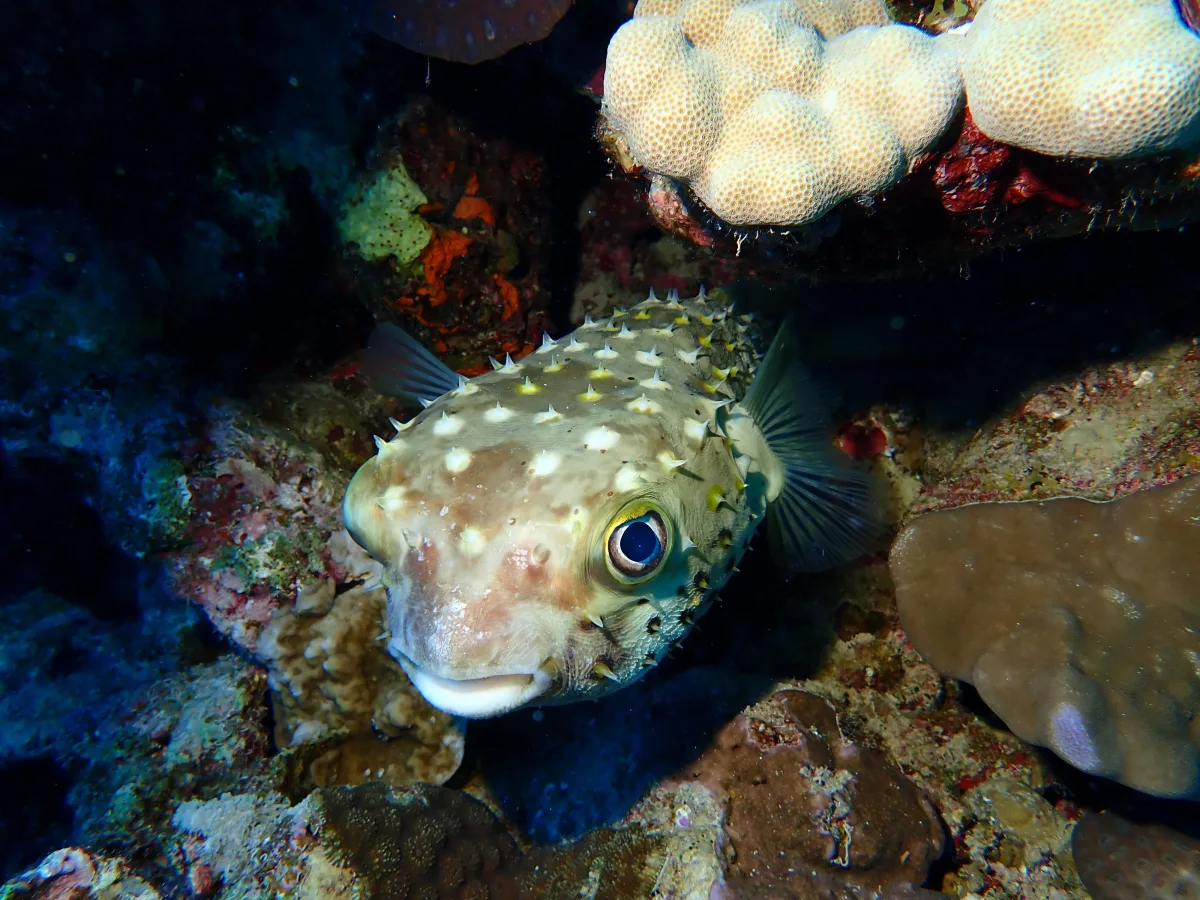
A pufferfish blown up into a spiky ball is one of the most-wanted photos on a reef, and some divers poke one to get it. It looks harmless, like a party trick. It is not: the puff is an emergency escape, and it costs the fish far more than the few seconds you see.
Puffers and porcupinefish
Pufferfish (family Tetraodontidae) and porcupinefish (Diodontidae) are close relatives, and both can inflate. The difference you can see is the spines: FishBase describes the Spotted Porcupinefish as covered with long, sharp spines that lie folded backwards when the fish is not inflated, while many puffers have only small prickles in their skin.
Both have strong teeth fused into a beak. FishBase describes the porcupinefish's teeth as united in each jaw, and lists hard-shelled prey such as sea urchins, sea snails and hermit crabs in its diet: a beak is the right tool for cracking shells.
How the puff works
When a puffer is threatened, it first tries to escape, then rapidly gulps water and swells into a ball that is too big and awkward for many predators to swallow. Scientists long assumed that the fish holds its breath while inflated. A 2014 study in Biology Letters (McGee and Clark) tested that on the black-saddled toby (Canthigaster valentini), a small reef puffer, and found the opposite: the fish kept breathing through its gills, and its oxygen uptake rose to five times its resting level.
What one puff costs
The same study measured what happens afterwards. Once the fish had deflated, it took an average of 5.6 hours for its metabolism to recover. The authors also point to earlier work in which the long-spined porcupinefish could no longer inflate after several puffs in a row. In other words, a fish made to puff up for a photo can spend the rest of the morning recovering, and it may be less able to defend itself against a real predator.
The poison inside
Many puffers carry tetrodotoxin, one of the strongest natural poisons known. Hong Kong's Centre for Food Safety calls it over 1,000 times more toxic to humans than cyanide, according to some authorities. It is most concentrated in the ovaries, liver, intestines and skin, it cannot be destroyed by cooking, freezing or drying, and there is no antidote. Where it comes from is not fully understood: bacteria have been linked to producing it, and the fish probably take it in through their food. FishBase lists four of the five species below as poisonous to eat.
A puffer with a double
The black-saddled toby from the 2014 study has a lookalike. FishBase notes that it forms shoals of 10 to 100 or more fish, often with the filefish Paraluteres prionurus, which makes up about 5% of the shoal and copies the toby's colours for protection. A predator that has learned to avoid the poisonous toby also leaves its harmless double alone.
Pufferfish on ScubaSnap
Divers have uploaded pictures of five puffer and porcupinefish species to ScubaSnap so far. Here they are, with a few facts from FishBase:
- Blackspotted Puffer: Indo-Pacific, from East Africa to Micronesia and Samoa, up to about 33 centimetres, at 0 to 60 metres. Its body is covered with prickles and large black spots, and adults are often seen in pairs. It feeds on coral (usually the tips of Acropora), crustaceans, molluscs, sponges and algae.
- Masked Puffer: found only in the Red Sea, where it replaces the Blackspotted Puffer. It reaches about 30 centimetres and lives on coral-rich fringing reefs. FishBase notes that some scientists consider the two the same species.
- Spotted Porcupinefish: found in tropical seas around the world, up to about 91 centimetres, although around 40 is more usual. Solitary and active at night, and often seen in caves and holes on shallow reefs during the day. Young fish up to about 20 centimetres live in open water.
- Longspined Porcupinefish: also found worldwide in the tropics, usually around 15 centimetres and up to about 50. Adults have dark blotches across the back, and young fish often drift with floating sargassum weed. FishBase calls it a relatively poor swimmer, which is one more reason the puff matters.
- Valentin's Sharpnose Puffer, the black-saddled toby: from the Red Sea and South Africa to the Tuamotu Islands, up to about 11 centimetres, with two dark bars down its side to the belly. FishBase notes that the males are territorial and often seen fighting.
Most of them are together in the pufferfish list in the species guide. Not sure which one you saw? Upload your photo to the AI fish identifier.
Diving around pufferfish
Never touch, poke or chase a pufferfish to make it puff up. One puff can cost it hours of recovery. Green Fins asks divers never to touch, chase or handle marine life, and never to manipulate an animal for a photo.
- Look in the holes. Porcupinefish are active at night and often rest in caves and crevices during the day, so a careful look into a hole from a distance may show you one. Do not reach in.
- Try a night dive. Both porcupinefish species feed at night, so night dives are a good time to see them out in the open.
- Photograph them relaxed. A calm puffer with its fins moving and its spines flat is the better photo, and the one that shows the fish as it really is. Our tips for photographing fish help you get it, and our eight habits of reef etiquette cover the rest.
- Never eat one you catch. Tetrodotoxin survives cooking and there is no antidote, says Hong Kong's Centre for Food Safety.
The short version
- Puffers and porcupinefish both inflate by gulping water; porcupinefish have long spines that stand up
- They keep breathing while inflated, but recovery takes hours: 5.6 on average in one study
- Many carry tetrodotoxin, which cooking does not destroy
- The black-saddled toby has a filefish double
- Five species with pictures on ScubaSnap
- Never make one puff up, and never touch or chase it
Sources and further reading
- All puffed out: do pufferfish hold their breath while inflated? (McGee and Clark, Biology Letters, 2014): breathing and recovery during inflation.
- Tetrodotoxin: the deadly poison in puffer fish (Centre for Food Safety, Hong Kong, 2021): toxicity, where the toxin sits, and why cooking does not help.
- FishBase species pages: Blackspotted Puffer, Masked Puffer, Spotted Porcupinefish, Longspined Porcupinefish and Valentin's Sharpnose Puffer: size, range, diet, behaviour and mimicry.
- Managing Photographers (Green Fins): best practice for divers with cameras.