


Moray Eels: What the Open Mouth Really Means
The wide-open mouth of a moray eel is not a threat: it is how the animal breathes. Why morays look the way they do, how they hunt (with a second set of jaws, and sometimes with a grouper), the six species on ScubaSnap, and how to behave around them.
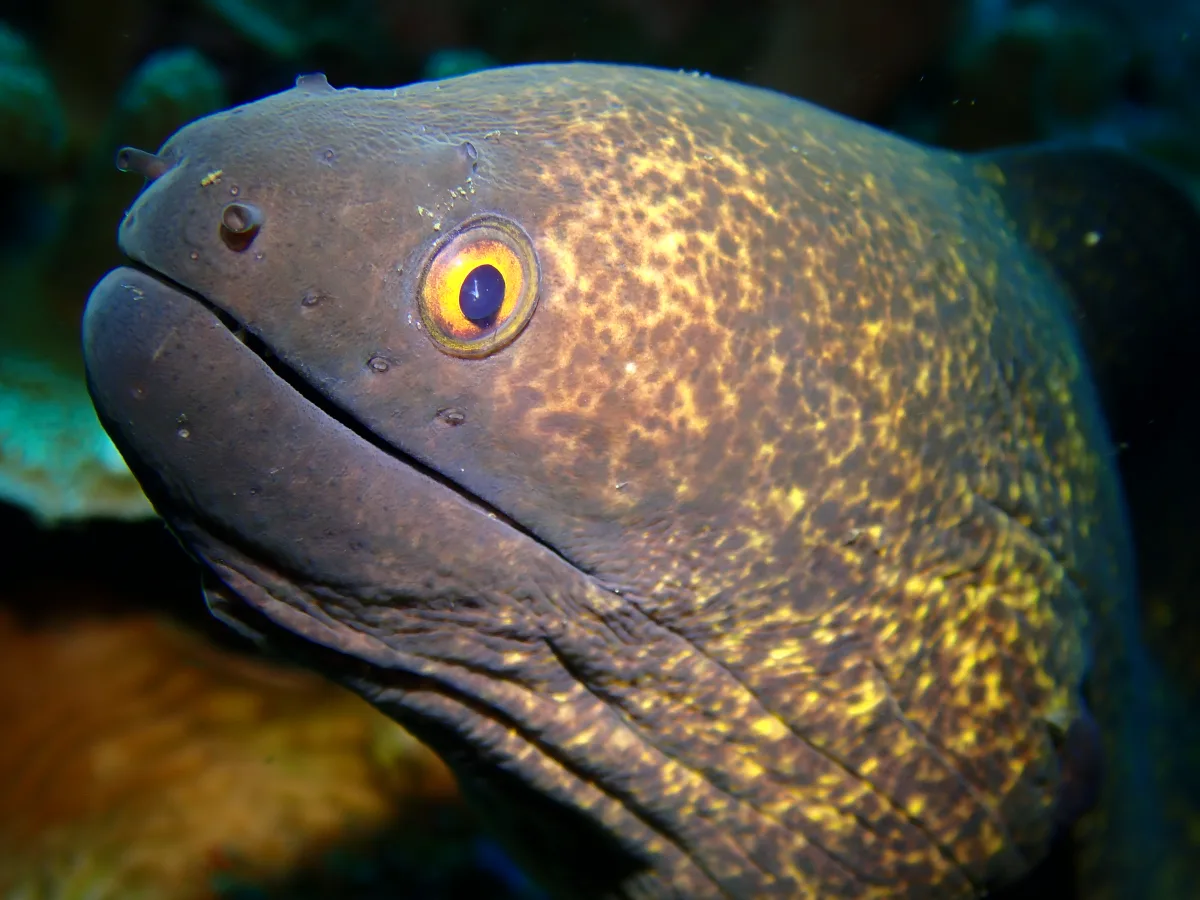
You shine a torch into a crevice and a head looks back, mouth open, teeth showing. It looks like a warning. It is not, and once you know what a moray eel is doing, the whole animal makes more sense.
Why the mouth never closes
A moray lives in a hole and waits. To breathe, it has to keep water moving over its gills, and it does that by opening and closing its mouth so the water passes through. The wide-open mouth is breathing, not a threat. Western Australia's parks agency puts it simply: the mouth is open to let water pass through the gills.
That does not make a moray harmless. FishBase says the vicious reputation is undeserved, although some species will bite if provoked, and Divers Alert Network (DAN) notes that marine bites are rare and often happen when the animal feels threatened and defends itself or its territory.
What a moray is
There are more than 200 species of moray eel, found worldwide in tropical and temperate seas. They are long and scaleless, with no pectoral or pelvic fins: one long fin runs along the back and round the tail. The mouth is large and full of sharp teeth, and the diet is mainly crustaceans, octopus and squid, and small fish. Adults live among rocks and coral heads, and many species hide in holes and crevices by day and are more active at night. Sizes range from small species well under a metre to the giant moray, which reaches about three metres.
Poor eyes, excellent nose
Some morays have poor eyesight, but morays have an excellent sense of smell: their nostrils are drawn out into tubes, according to the Australian Museum. That suits an animal that hides in the reef and waits for a meal to swim by.
A second set of jaws
A moray is poor at sucking its prey into its mouth, the way many fish feed. Instead it has a second set of jaws in its throat. When it strikes, it grabs the prey with its front teeth, and the throat jaws shoot forward into the mouth, grip the prey and drag it back towards the gullet. This was described in a 2007 study published in Nature, as the first known case of a vertebrate using a second set of jaws to hold and move its prey.
Hunting with a grouper
Morays do not always hunt alone. In the Red Sea, researchers watched groupers (Plectropomus pessuliferus) shake their heads in front of resting giant morays to recruit them for a joint hunt. The moray can follow prey into the crevices of the reef while the grouper hunts the open water around it, so a fish that escapes one predator runs into the other. Both partners benefit, according to the 2006 study in PLoS Biology.
Moray eels on ScubaSnap
Divers have uploaded pictures of six moray species to ScubaSnap so far. Here they are, with a few facts from FishBase:
- Giant Moray: the largest Indo-Pacific moray, up to about 3 metres. It lives on reefs from the Red Sea across the Indo-Pacific, usually in a hole, and it has the most pictures from divers here.
- Green Moray: a western Atlantic species, from Bermuda and the Gulf of Mexico to Brazil, up to about 2.5 metres. Dark green to brown, and it feeds mainly at night.
- Yellow-edged Moray: from South Africa through the Red Sea across the Indo-Pacific, up to about 2.4 metres. A yellowish body mottled with dark brown, a purplish-grey head and a black blotch at the gill opening. Solitary and curious, and usually seen with its head sticking out.
- White-spotted Moray: Indo-Pacific, up to about 1.2 metres. Dark skin with small white spots, and a mouth that is white inside.
- Yellowmouth Moray: Indo-Pacific including the Red Sea, up to about 1.8 metres, with yellow inside the mouth. FishBase notes that its mucus is toxic, one more reason never to touch a moray.
- Gray Moray: a small moray of the Red Sea and the western Indian Ocean, up to about 65 centimetres. FishBase calls it the geometric moray.
To see all the moray pictures in one place, open the moray eel list in the species guide. Two dive sites in our directory are named after them: Moray Garden in Egypt and Moray Alley in the Bahamas. Not sure which moray you saw? Upload your photo to the AI fish identifier.
Diving around morays
Never feed a moray, and never put a hand or a camera into a hole you cannot see into. Western Australia's parks agency strongly discourages feeding eels because it can make eels that are looking for food aggressive towards divers.
- Keep your buoyancy. Swim just above the reef, so you do not bump into an eel that is out of sight in a crevice.
- Give it room. A moray with its head out of a hole is a patient subject for a photo, but do not corner it or crowd it. Our tips for photographing fish apply to eels too.
- Take a bite seriously. DAN says an eel bite can be very painful because of the way the teeth are arranged, and it can easily become infected. Control the bleeding with direct pressure, rinse the wound with clean water, and have a doctor look at it.
The short version
- The open mouth is breathing, not a threat
- More than 200 species, no scales and no pectoral or pelvic fins
- Shy hunters of the reef: good nose, poor eyes, and a second set of jaws in the throat
- Sometimes they hunt with a grouper
- Six species with pictures on ScubaSnap
- Do not feed them, do not reach into holes, and stay above the reef
Sources and further reading
- Moray eels (Department of Biodiversity, Conservation and Attractions, Western Australia): the open mouth, and advice for divers.
- Muraenidae, moray eels (FishBase): the family, with a page for each species.
- Green Moray (The Australian Museum): eyesight, smell and fins.
- Raptorial jaws in the throat help moray eels swallow large prey (Mehta and Wainwright, Nature, 2007).
- Interspecific communicative and coordinated hunting between groupers and giant moray eels in the Red Sea (Bshary and colleagues, PLoS Biology, 2006).
- Well, this bites: prevention and treatment of marine bites (Divers Alert Network).