


Peacock Mantis Shrimp: The Fastest Punch in the Ocean
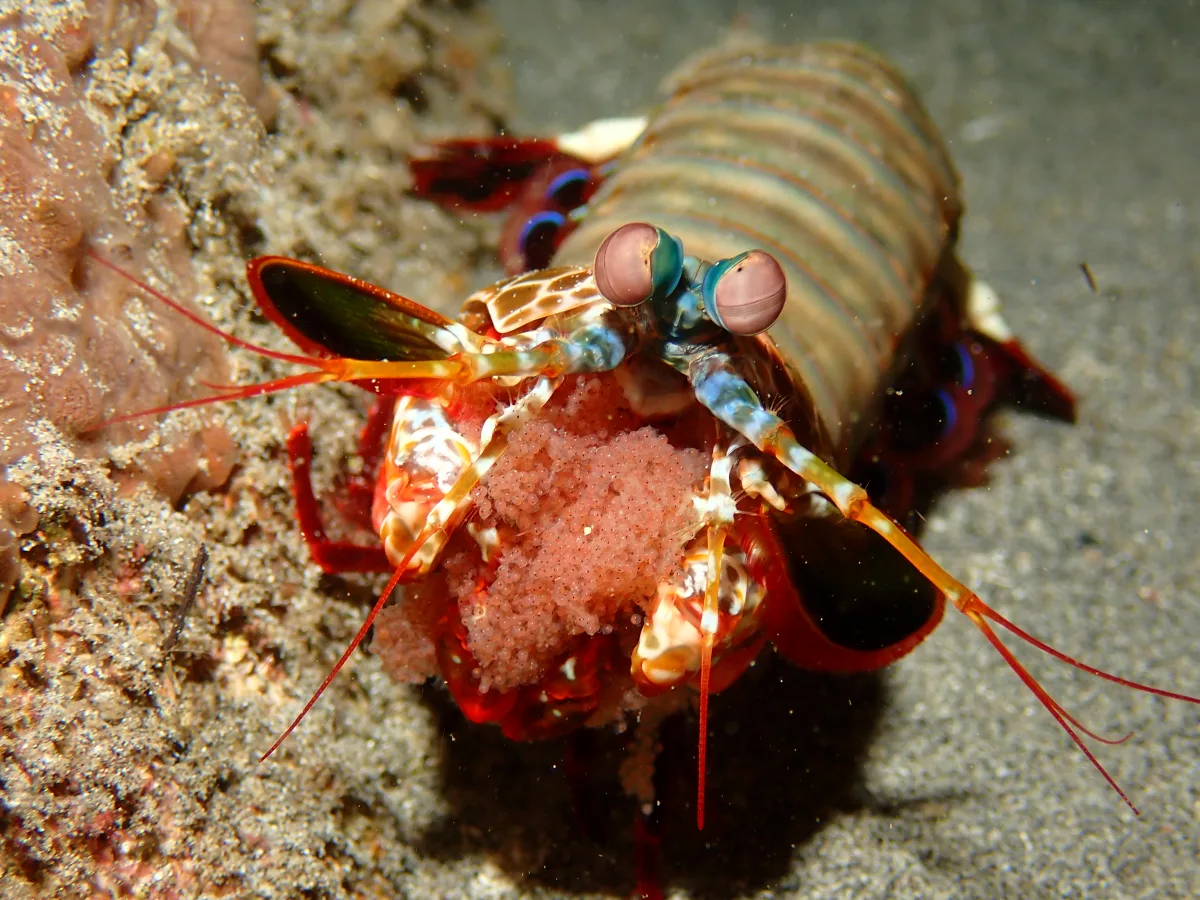
You shine a torch over a patch of coral rubble and two stalked, brightly colored eyes swivel independently to track your motion. Out peeks a crustacean painted in kaleidoscopic greens, blues, and oranges: a mantis shrimp. It looks like a slow-moving reef jewel, but beneath that vivid exterior sits the fastest punch in the animal kingdom.
A strike faster than a bullet
A mantis shrimp does not bite or nip—it strikes with specialized, heavily reinforced raptorial appendages. The punch reaches speeds of over 80 km/h (50 mph) in milliseconds, accelerating faster than a .22 caliber bullet. The impact delivers more than 1,500 Newtons of force, easily smashing through hard crab shells, snail valves, and even glass aquarium walls.
The strike is so rapid that it causes cavitation in the water: a low-pressure vapor bubble forms and instantly collapses. This collapse creates an intense shockwave, emitting extreme heat and a flash of light, which can stun or kill prey even if the physical club misses.
What a mantis shrimp is
Mantis shrimps are stomatopod crustaceans, distinctly separate from true shrimps, lobsters, or crabs. There are more than 450 species worldwide, ranging from shallow tropical reefs to temperate waters. They are broadly divided into two hunting groups: "spearers," which use spiny appendages to snag soft-bodied fish, and "smashers," which use club-like limbs to crack open hard-shelled prey. Adults build burrows in sand, gravel, or dead coral heads, often leaving only their eyes exposed.
Simple brain, incredible vision
While humans rely on 3 color receptors (red, green, and blue) to see the world, the peacock mantis shrimp possesses 16 photoreceptors. According to research published in Science, they detect polarized light, ultraviolet radiation, and deep infrared waves. Each stalked eye moves independently and offers trinocular vision, giving them complex depth perception within a single eye to spot camouflaged prey across the reef.
Monogamy and master builders
Mantis shrimps display surprisingly complex social behaviors. Many species are monogamous and can stay with the same partner for up to 20 years, sharing burrows and parental duties. They engineer intricate U-shaped tunnels beneath coral rubble, reinforcing the walls with a mixture of sand grains, shell fragments, and sticky mucus secretions.
Mantis shrimps on ScubaSnap
Divers have shared sightings and photographs of several stomatopod species on ScubaSnap. Here are a few notable species cataloged in our guide:
- Peacock Mantis Shrimp: the most iconic smasher species of the Indo-Pacific, famous for its rainbow-colored body, leopard-spotted carapace, and intense curiosity.
- Zebra Mantis Shrimp: the largest species of mantis shrimp, reaching up to 40 centimetres. It is a soft-bottom spearer with distinct black and yellow stripes.
- Purple-spotted Mantis Shrimp: a smaller Indo-Pacific smasher species frequently found in shallow intertidal reef flats and coral heads.
Explore all crustacean sightings in our mantis shrimp list within the species guide. Wondering which species you spotted on your dive? Upload your photo to the AI fish identifier.
Diving around mantis shrimps
Never put a finger, glass lens port, or macro wand directly near the entrance of a mantis shrimp burrow. A strike on an aluminum housing is harmless to gear, but a direct hit can shatter delicate plastic dome ports or break human fingers.
- Maintain neutral buoyancy. Keep your fins elevated above coral rubble slopes so you do not collapse their sandy burrows or damage delicate macro habitats.
- Be patient with your lighting. Their eyes are exceptionally sensitive to light. Use low-power focus lights or diffusers over your strobes to capture clean macro shots without blinding the animal.
- Give them room to retreat. A curious mantis shrimp will often watch you from its doorway. Avoid blocking its exit or crowding the burrow entry with bulky camera rigs.
The short version
- The strike moves faster than a bullet and generates cavitation shockwaves
- More than 450 species divided into smashers and spearers
- 16 color receptors capable of detecting polarized and UV light
- Many species mate for life and construct reinforced sand burrows
- Featured species and macro galleries available on ScubaSnap
- Keep fingers and plastic lens ports away from burrow entrances
Sources and further reading
- A Different Way of Seeing Color: Stomatopod Vision (Thoen and colleagues, Science, 2014): the 16 photoreceptor visual system.
- Patek et al.: Deadly strike mechanism of a mantis shrimp (Nature, 2004): kinematics of the raptorial strike and cavitation bubbles.
- Roy's List of Stomatopods for the Aquarium (University of California Museum of Paleontology): comprehensive species guide and behavioral notes.
- Marine Wildlife Safety Guidelines (Divers Alert Network): advice on avoiding aquatic creature injuries.