


Lionfish, Stonefish and Scorpionfish: The Reef’s Venomous Spines
One is the showiest fish on the reef, one looks like a rock and one walks on its fins. All carry venom in their spines. How to spot them, and why lionfish are invading.
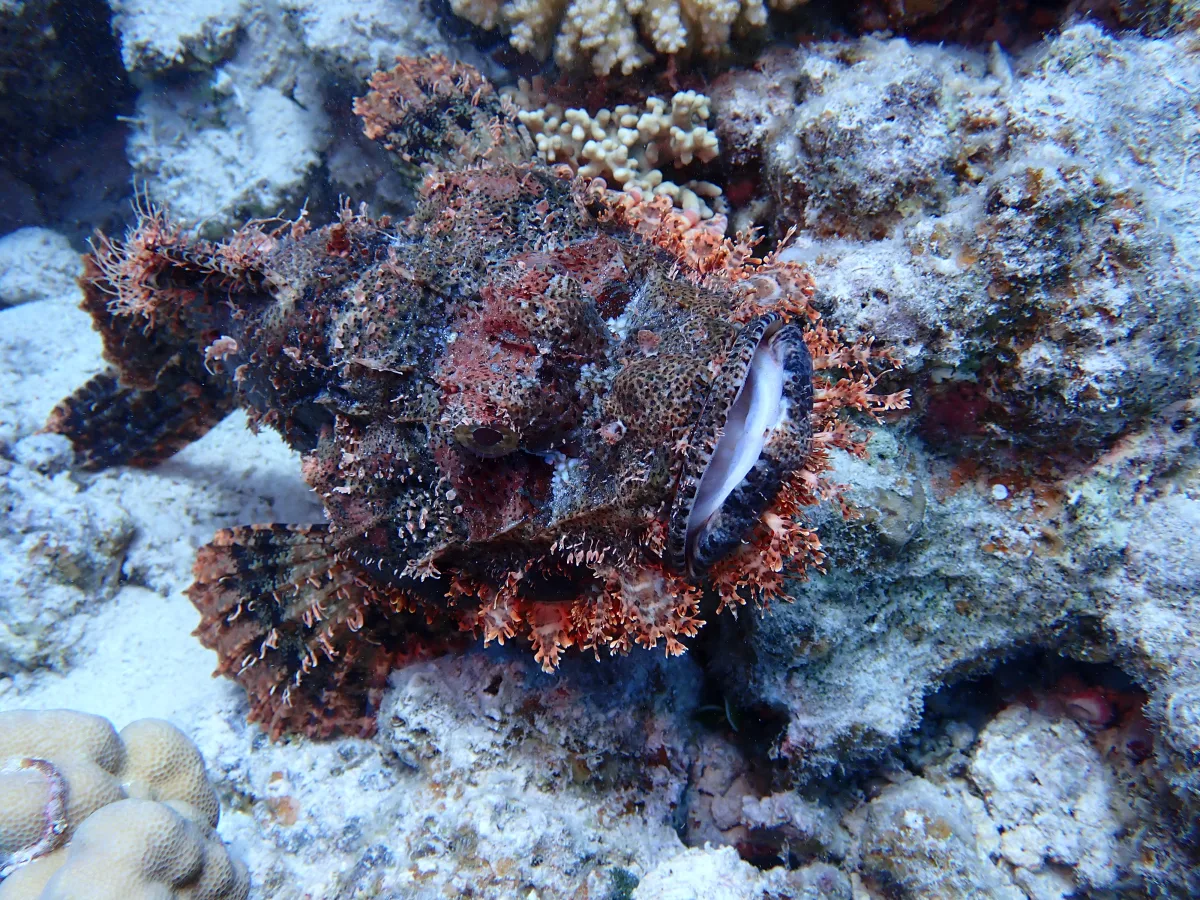
One is the showiest fish on the reef, one looks exactly like a rock, and one walks along the bottom on its fins. They have one thing in common: venomous spines. Here is how to recognise them, why one of them has become a problem on the other side of the world, and how to dive near them without getting stung.
Venom in the spines
Lionfish, stonefish and devilfish belong to the scorpionfish group, and all defend themselves with venomous fin spines. They do not attack: the venom is for defence, and stings happen when a person touches, steps on or grabs one. The danger varies a lot. DAN's Alert Diver (Becker and Auerbach, 2011) says lionfish stings can cause significant pain but are rarely fatal, while the stonefish can deliver a fatal sting.
Lionfish: hunters with wings
By day the Red Lionfish often hides head down and practically motionless, according to FishBase. At night it hunts small fish, shrimps and crabs: it spreads its wide pectoral fins to trap prey in a corner, stuns it and swallows it in one go.
There are two very similar lionfish. FishBase gives the Red Lionfish (Pterois volitans) a Pacific range from Western Australia to the Marquesas, and says it is replaced by the devil firefish (Pterois miles) from the Red Sea to Sumatra. So the lionfish you see in the Red Sea is P. miles, and FishBase notes its fin spines are highly venomous and can cause human death.
Lionfish in the Atlantic
Lionfish are native to the Indo-Pacific, but they are now established along the southeast coast of the United States, in the Caribbean and in parts of the Gulf, says NOAA. The exact cause is unknown, but experts suspect people released unwanted lionfish from home aquariums. With few predators there, lionfish eat small fish and crustaceans, including young snapper and grouper. NOAA says their full impact is not yet known, but its researchers have concluded the population will keep growing and cannot be eliminated with conventional methods. FishBase also records P. miles in the eastern Mediterranean.
If you dive in an invaded area, ask your dive operator about local lionfish rules. Never try to handle one yourself.
Stonefish: the rock that stings
FishBase calls the stonefish (Synanceia verrucosa) the world's most venomous fish. Its colours match its surroundings so well that it is extremely hard to see, sometimes even covered with algae, and it sits on sand and rubble on reef flats, in shallow lagoons and even in tide pools. It has 12 to 14 stout grooved spines, each with a large venom sac at its base. The stings are excruciatingly painful and occasionally fatal, and FishBase notes that an antivenom works if given immediately.
Devilfish: walking on its fins
The spiny devilfish (Inimicus didactylus), which FishBase calls the bearded ghoul, has two lower rays of each pectoral fin free and uses them as walking legs. The inside of the fin is brightly coloured, and it flashes those fins to startle predators. It often half-buries itself in sand or silt and is easily overlooked, which FishBase says presents a real danger, because its venom can be deadly.
Scorpionfish on ScubaSnap
Divers have uploaded pictures of five of these species to ScubaSnap so far, with facts from FishBase:
- Red Lionfish: Pacific, up to about 46 centimetres, at 2 to 55 metres. Also the main invader of the Atlantic.
- Common Lionfish, the devil firefish: from the Persian Gulf and Red Sea to South Africa and Sumatra, up to about 43 centimetres, reddish to tan or grey with many thin dark bars.
- Clearfin Lionfish, which FishBase calls the radial firefish: Red Sea to the Society Islands, up to about 24 centimetres. It prefers rocky reefs, hides under ledges by day and feeds only on small crabs and shrimps.
- Stonefish: Red Sea and East Africa to French Polynesia, up to about 40 centimetres, at 0 to 30 metres. The most widespread stonefish.
- Spiny Devilfish: Thailand to Vanuatu and Australia, up to about 25 centimetres, on open sand and silt at 5 to 80 metres.
All of them are together in the scorpionfish list in the species guide. Our directory even has a Lionfish Wall in Yap. Not sure what you saw? Upload your photo to the AI fish identifier, and look closer on a night dive, when lionfish hunt.
Diving around venomous fish
Never touch, corner or handle any of these fish, and never put a hand or knee down on sand or rubble you have not checked. A stonefish or devilfish can be lying right there, invisible. Green Fins asks divers never to touch marine life or rest on the seabed.
- Keep your buoyancy. Stay off the bottom, especially over the sand and rubble that stonefish and devilfish favour.
- Mind shore entries. Stonefish live in shallow lagoons and tide pools, and DAN advises extra care when entering or leaving the water from shore.
- Do not crowd a lionfish for a photo. Give it room and never corner it against the reef. Our tips for photographing fish work at a respectful distance.
- If someone is stung, soak the wound in hot water that is not scalding, clean it and get medical help, straight away for a stonefish. Our marine-life first aid post has DAN's full advice.
The short version
- Lionfish, stonefish and devilfish all carry venom in their spines, for defence only
- Lionfish stings are very painful but rarely fatal; a stonefish sting can kill
- Two lionfish: P. volitans in the Pacific, P. miles from the Red Sea to Sumatra
- Lionfish are invasive in the western Atlantic and Caribbean
- Stonefish and devilfish hide on sand and rubble: never put a hand or knee down unchecked
- Five species with pictures on ScubaSnap
Sources and further reading
- Why are lionfish a growing problem in the Atlantic Ocean? (NOAA National Ocean Service): the invasion and its effects.
- Marine Envenomations: Vertebrates (Becker and Auerbach, DAN Alert Diver, 2011): how dangerous the stings are, and first aid.
- FishBase species pages: Red Lionfish, Devil Firefish, Radial Firefish, Stonefish and Bearded Ghoul: range, size, behaviour and venom.
- Managing Photographers (Green Fins): no touching and no resting on the seabed.