


Juvenile Fish: When the Young Look Like a Different Species
A dark fish with white rings that grows into a yellow-and-blue angelfish, a batfish that drifts like a dead leaf: young reef fish that look nothing like their parents.
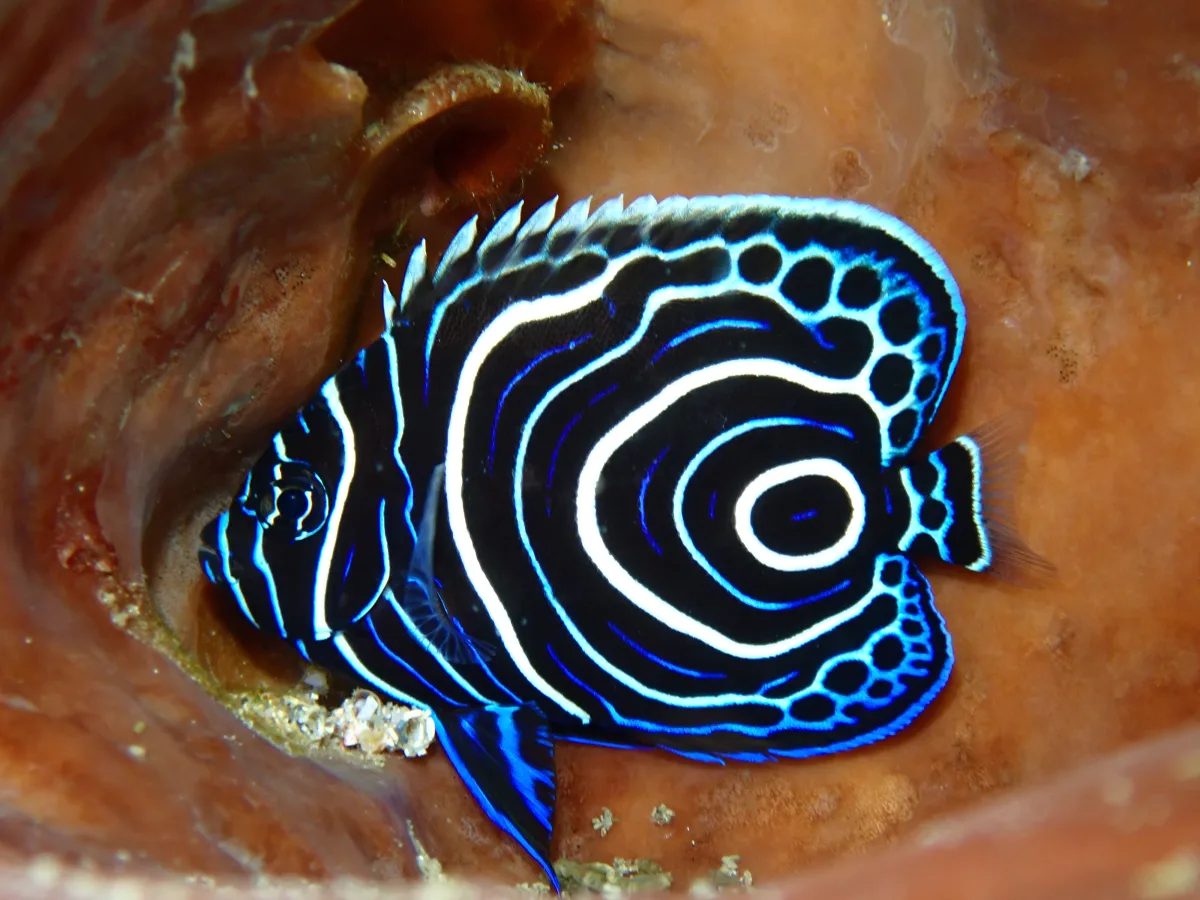
You photograph a small dark fish with white rings, and later learn it is a young Emperor Angelfish, a fish you know as yellow and blue. On a reef, many young fish look nothing like their parents. Here is why, five species that change completely as they grow, and what it means when you try to identify one.
Why the young dress differently
One explanation has been tested in cleaner wrasse. In a 1998 study at the University of Hawai'i, Jeffrey Mahon found that adult female cleaner wrasse attacked small cleaners more often when the small fish wore adult colours. Looking like a juvenile gave some protection from the adults of the same species. It had a price, though: juvenile colours also meant less food, and hungry juveniles switched to adult colours faster.
Other juveniles look different to hide. Some disguise themselves as something else entirely, such as a leaf or a toxic flatworm. Whether one reason explains every species is less clear, because many have never been tested.
Five fish that change completely
Emperor Angelfish
The Australian Museum describes the juvenile as dark blue-black with a white ring on the rear of the body, surrounded by incomplete circles of blue and white. The adult has diagonal yellow and purplish-blue stripes and a curved black bar over the eye. The museum notes that angelfish of this genus, Pomacanthus, are known for dramatic colour changes as they grow.
Bicolour Parrotfish
This one has three looks. Fishes of Australia describes the Indo-Pacific bicolour parrotfish (Cetoscarus ocellatus) as white with a broad orange band around the head and a black eyespot on the dorsal fin when young. Females are dark purplish to reddish brown, peppered with black spots, and males are green with pink spots. The parrotfish on ScubaSnap is its Red Sea counterpart, Cetoscarus bicolor, which FishBase lists as found only in the Red Sea.
Yellow Boxfish
According to FishBase, juveniles are bright yellow with black spots. As they grow, the spots shrink in proportion and the yellow fades to a dirty mustard, and large adults turn bluish with yellow seams between the plates of their box. Juveniles are often found among branching Acropora coral, and small ones hide in narrow crevices.
Orbicular Batfish
Fishes of Australia, which calls it the Round Batfish, says juveniles shelter in mangroves and sheltered lagoons, often among floating debris, where they mimic dead floating leaves: small juveniles are yellowish to reddish-brown. FishBase describes adults as yellowish silvery or dusky with a dark bar through the eye, living over sand in deeper lagoons and on seaward reefs, and reaching about 60 centimetres.
Harlequin Sweetlips
FishBase notes that small juveniles may mimic a toxic flatworm, and that they live among corals. Adults can reach about 72 centimetres and rest alone under ledges or in caves by day, feeding at night.
What this means for identification
Juveniles are a classic reason for a wrong identification. The AI fish identifier sees only your photo: it does not know how big the fish was, or that it might be young. Our post on how the AI identifier works and when it is wrong explains more. To give yourself the best chance:
- Note the size. Write down roughly how long the fish was. A 4-centimetre fish is unlikely to be an adult of a species that grows to 60.
- Check the juvenile description. FishBase and Fishes of Australia often describe juvenile colours separately.
- Get a clear side-on shot. Our tips for photographing fish help.
- Flag what looks wrong. From your identification history, so the team can review it.
Stripes change too: young clownfish gain their white stripes one by one, and some carry extra stripes their parents do not have. Our clownfish post explains how.
Juveniles on ScubaSnap
Pictures of all these species are in the species guide, whether divers photographed them young or grown: the Emperor Angelfish and its relative the Yellowbar Angelfish, the Bicolor Parrotfish, the Stoplight Parrotfish (whose females and males also look different, according to FishBase), the Yellow Boxfish, the Orbicular Batfish, the Longfin Batfish (whose small juveniles gather under floating debris and sargassum, FishBase says) and the Harlequin Sweetlips. Photographed a juvenile? Upload it: every young fish makes the species guide more useful.
Diving around juveniles
Young fish hide in crevices, among branching coral and under ledges. Never reach in or chase them out. Green Fins asks divers never to touch, chase or move marine life for a photo.
- Know where to look. Mangroves and sheltered lagoons for young batfish (Fishes of Australia), branching coral for young boxfish (FishBase), ledges near cleaner shrimps for young Emperor Angelfish (Australian Museum). Our cleaning stations post explains how to watch those shrimps without disturbing them.
- Keep your buoyancy. Branching coral breaks easily, and juveniles live in it. Hover, do not kneel.
- Be patient. A small fish that bolts into a crevice usually comes out again if you stay still at a distance.
The short version
- Many young reef fish look nothing like the adults
- Juvenile colours can protect them from adults of their own species, at the cost of less food
- Some juveniles hide as leaves or copy toxic flatworms
- Emperor Angelfish, Bicolour Parrotfish, Yellow Boxfish, Orbicular Batfish and Harlequin Sweetlips all change completely
- Note the size and check juvenile descriptions when you identify a fish
- Never chase a juvenile out of its hiding place
Sources and further reading
- The advantage of juvenile coloration in reef fishes (Mahon, University of Hawai'i, 1998): juvenile colours and aggression in cleaner wrasse.
- Emperor Angelfish (The Australian Museum): juvenile and adult colours.
- Bicolour Parrotfish and Round Batfish (Fishes of Australia): juveniles, females and males; leaf-mimicking juveniles.
- FishBase species pages: Yellow Boxfish, Orbicular Batfish, Longfin Batfish, Harlequin Sweetlips, Bicolour Parrotfish and Stoplight Parrotfish.
- Managing Photographers (Green Fins): no touching, chasing or moving animals for a photo.