


Clownfish: Why Nemo’s Dad Would Have Become His Mum
Clownfish live in an animal that stings everything else, change sex from male to female, and keep themselves small on purpose. The science, and how to dive near them.
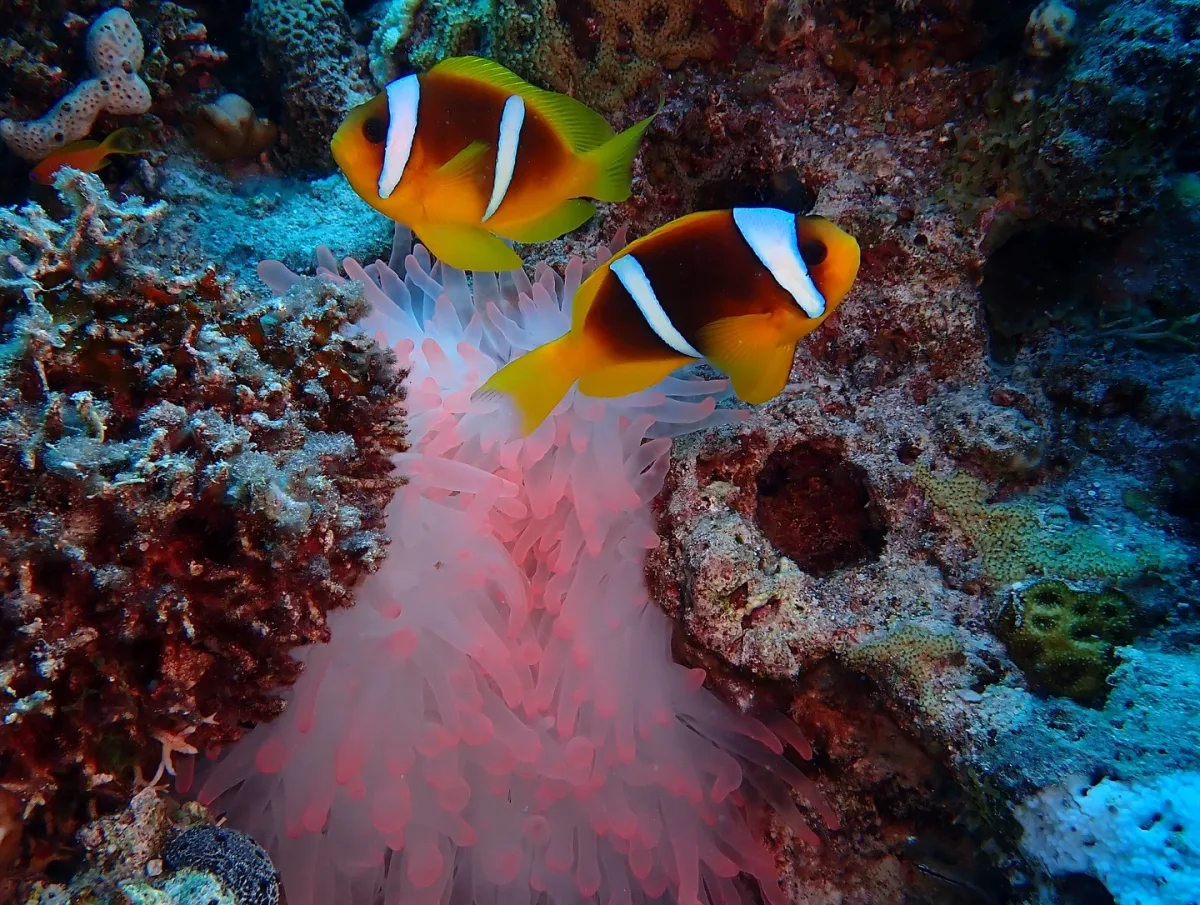
You find an anemone, and in it a small orange fish with white bars that darts out towards you and back into the tentacles. Every diver knows it as Nemo. The real animal is stranger than the film: it lives in a host that stings almost everything else, it can change sex, and it keeps itself small on purpose.
What a clownfish is
Clownfish, also called anemonefish, are a group of thirty-some species, according to France's national research centre CNRS. The species differ partly in how many white stripes they have, from none to three. Every clownfish lives with a sea anemone, and both sides gain: Fishes of Australia describes the anemone protecting the clownfish against predators, while the fish provides nutrients for the algae that live inside the anemone.
Why the anemone does not sting it
A sea anemone's tentacles are armed with stinging cells. A 2025 study in BMC Biology, led by the Okinawa Institute of Science and Technology (OIST), found that a sugar called sialic acid in a fish's skin mucus can trigger those cells, and that anemonefish keep very low levels of it in their mucus. The anemones themselves also lack these sugars in their own mucus, probably so they do not sting themselves. The researchers called it a Trojan horse strategy.
The protection is not there from birth. OIST reports that young larvae have normal sialic acid levels and get stung if they come close to an anemone. The levels drop after metamorphosis, when the fish develop their white stripes and orange colour.
A family where dad can become mum
Each anemone is home to a small group: usually one monogamous breeding pair plus young fish that do not breed. Fishes of Australia explains that anemonefish are protandrous hermaphrodites: they mature first as males and can later change into females. The female is always the largest fish in the group. If she dies, the largest male becomes the breeding female.
So in a real clownfish family, if Nemo's mother had died, his father would have become female. It can happen fast: FishBase notes that in a field test with the Red Sea species, a male laid eggs 26 days after the female was removed, and that Clark's Anemonefish completes the change in less than five to six months.
Staying small on purpose
The young fish in the anemone queue for a place in the breeding pair, and size decides the order. In a 2003 study in Nature, Peter Buston showed that orange clownfish (Amphiprion percula) adjust their size and growth rate to their rank, keeping a well-defined size gap below the fish ranked above them. He presented it as an unusual way to avoid conflict within the group.
Stripes that appear one by one
The white stripes are made of cells called iridophores, which contain reflective crystals. A 2018 study in BMC Biology (Salis and colleagues) found that the stripes appear one at a time, from head to tail, as the larva turns into a juvenile. Every species has three stripes at that stage. Species with fewer stripes as adults lose them again from the tail forwards, and some juveniles carry extra stripes that their parents do not have. That is one reason a young clownfish can be hard to identify from a photo.
Clownfish on ScubaSnap
Divers have uploaded pictures of three clownfish species to ScubaSnap so far:
- Clark's Anemonefish: the clownfish with the most pictures here. Fishes of Australia describes it as orange to almost black with three white bars, the middle one the broadest, and a white or yellow tail. It ranges from the Persian Gulf and India to Micronesia, southern Japan and Fiji, and lives with ten different anemone species. FishBase calls it the yellowtail clownfish and gives up to about 15 centimetres and depths of 1 to 70 metres.
- Red Sea Clownfish: found only in the Red Sea and the Chagos Archipelago, according to FishBase, which calls it the twoband anemonefish. Yellow-orange with two black-edged white bands, up to about 14 centimetres, at 1 to 30 metres.
- Pink Skunk Clownfish: pink to peachy-pink, with one narrow white bar behind the eye and a pale stripe along the back (Fishes of Australia). FishBase gives a western Pacific range from the Gulf of Thailand to Samoa and Tonga, a maximum of about 10 centimetres, a change from male to female at about 5.4 centimetres, and 2,000 to 4,000 eggs a year from one pair.
All the clownfish pictures are together in the clownfish list in the species guide. Three dive sites in our directory are named after the anemones or the film: Anemone City and Nemo in Egypt, and Anemone City in Indonesia. Not sure which clownfish you saw? Upload your photo to the AI fish identifier, and read when the AI can be wrong: juveniles are a classic case.
Diving around clownfish
Never touch the anemone or its fish. The anemone is an animal with stinging tentacles, and the clownfish depend on it. Green Fins asks divers never to touch, move or handle marine life for a photo.
- Let it come to you. A clownfish lives with its host anemone and does not wander far, so there is no need to chase it. Hover, wait, and it will come out again.
- Keep your buoyancy. Green Fins asks photographers never to lie on the seabed or rest equipment on coral. Anemones often sit among coral, so stay neutral and fin backwards to leave.
- Go easy with the strobe. Green Fins advises limiting strong lights and flashes, because they stress marine life. Our tips for photographing fish and our eight habits of reef etiquette apply here too.
- Look for the nest. FishBase notes that the male guards and aerates the eggs, which are stuck to a surface near the anemone. If a fish keeps fanning a patch of rock, give it extra room.
The short version
- Thirty-some species, all living with sea anemones
- Low sialic acid in their mucus keeps the anemone from stinging them
- They start as males; the largest fish is the female, and a male can become female
- Young fish keep themselves smaller than the fish ranked above them
- Stripes appear one by one, from head to tail
- Three species with pictures on ScubaSnap
- Do not touch the anemone, do not chase the fish, and go easy with the strobe
Sources and further reading
- Marine mystery solved: how anemonefish avoid stings from their sea anemone hosts (Okinawa Institute of Science and Technology, 2025): the sialic acid study in BMC Biology.
- Clown fish: whence the white stripes? (CNRS, 2018): number of species, stripes and iridophores.
- Ontogenetic and phylogenetic simplification during white stripe evolution in clownfishes (Salis and colleagues, BMC Biology, 2018).
- Size and growth modification in clownfish (Buston, Nature, 2003).
- Clark's Anemonefish, Eastern Clown Anemonefish and Pink Anemonefish (Fishes of Australia): identification, host anemones, social groups and sex change.
- Amphiprion clarkii, Amphiprion bicinctus and Amphiprion perideraion (FishBase): size, depth, range and reproduction.
- Managing Photographers (Green Fins): best practice for divers with cameras.